What Is A Barrier Coating?
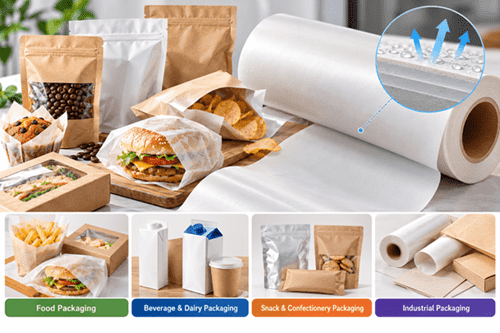
A barrier coating is a functional layer applied to paper or paperboard to reduce the penetration of moisture, oxygen, grease, water vapor, and other substances that can affect product quality. In barrier paper manufacturing, the coating transforms conventional paper into a packaging material with specific protective properties while retaining the advantages of a fiber-based structure.
For food manufacturers, packaging converters, importers, and wholesale buyers, understanding how barrier coatings work is essential when selecting materials for coffee packaging, snack bags, bakery products, dry ingredients, and other moisture-sensitive applications. The performance of High Barrier Paper depends not only on the coating formulation but also on base paper quality, surface preparation, application uniformity, drying conditions, and final inspection.
Different coating technologies deliver different levels of protection. water-based barrier coatings, for example, can provide moisture resistance, grease resistance, or oxygen barrier performance depending on their formulation and layer structure. Choosing the right barrier coated paper therefore requires evaluating the intended packaging application, processing requirements, and measurable performance targets.
What Does a Barrier Coating Do in Paper Packaging?
A barrier coating creates a functional layer that restricts the movement of substances through the porous fiber network of paper. Uncoated paper naturally absorbs liquids and allows gases and water vapor to pass through its interconnected pores. A properly engineered coating reduces these pathways and improves the material's suitability for protective packaging.
The specific function depends on the coating chemistry and its interaction with the paper surface.
Moisture barrier: Reduces water absorption and helps protect products from humid environments.
Oxygen barrier: Limits oxygen transmission to help preserve oxidation-sensitive ingredients and maintain product quality.
Grease barrier: Prevents oils and fats from penetrating the paper, making the material suitable for bakery and fast-food packaging.
Liquid resistance: Reduces wetting and penetration when the coating is designed for direct liquid exposure.
Water vapor barrier: Controls moisture transfer between the packaged product and its surrounding environment.
These properties are not interchangeable. A paper grade with excellent grease resistance may still provide insufficient oxygen protection. Likewise, a coating that performs well under dry laboratory conditions may lose some barrier effectiveness at high relative humidity. Buyers should specify the required performance rather than relying on general descriptions such as high barrier or waterproof.
Which Materials Are Used in Barrier Coatings?
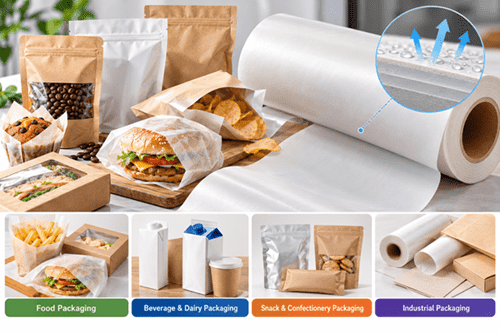
The coating formulation determines how the finished paper interacts with water, oil, gases, and converting equipment. Manufacturers select materials according to the required barrier properties, production method, regulatory requirements, and end-use conditions.
Water-based barrier coatings use water as the primary liquid carrier and typically contain functional polymers, dispersions, additives, and other formulation components. Depending on the chemistry, these coatings can improve grease resistance, moisture resistance, or oxygen barrier performance. They are attractive for paper-based packaging because they can support reduced reliance on conventional plastic films or foil laminates in suitable applications.
However, water-based does not automatically mean biodegradable, compostable, recyclable, or universally repulpable. Those characteristics depend on the complete formulation, coating weight, paper structure, and the recycling or composting system involved.
Other coating technologies include wax-based treatments, polymer coatings, mineral-based layers, and multilayer structures that combine different functional materials. Some applications use several thin layers rather than one thick layer because individual layers can serve different purposes, such as sealing surface pores, providing grease resistance, or reducing gas transmission.
When selecting high barrier coated paper, buyers should request the relevant technical data, including oxygen transmission rate (OTR), water vapor transmission rate (WVTR), grease resistance, coating weight, and test conditions. These measurements provide a more reliable basis for comparison than coating type alone.
How Is Barrier Paper Manufactured?
Producing consistent barrier paper packaging requires coordinated control of the paper substrate, coating application, drying, and finishing operations. Each stage influences the next, so defects introduced early in production can remain visible or become more serious after converting.
1. Base Paper Selection and Surface Preparation
The process begins with selecting a paper substrate that meets the required grammage, thickness, stiffness, surface smoothness, and mechanical strength. Fiber composition, refining conditions, formation uniformity, and residual moisture influence how the coating spreads and bonds to the sheet.
Paper that is excessively porous can absorb the liquid phase of a coating too quickly, leaving insufficient functional material near the surface. Conversely, a poorly wetted surface can cause uneven coverage, pinholes, or local coating defects. Variations in paper thickness and surface roughness can also create fluctuations in coating weight and barrier performance.
Before coating, manufacturers may use surface sizing, calendering, cleaning, or other substrate-conditioning operations to improve surface consistency. The objective is not simply to create a smooth sheet. It is to establish a controlled interface that allows the coating to spread uniformly, anchor to the fibers, and form a continuous barrier.
Critical quality controls: Base paper grammage, moisture content, thickness, surface smoothness, porosity, tensile strength, and visible contamination should be checked before the coating stage. Poor substrate consistency is difficult to correct through coating formulation alone.
2. Barrier Coating Formulation and Preparation
Once the substrate is selected, the coating formulation is prepared and adjusted to meet application and performance requirements. Important variables include polymer concentration, viscosity, solids content, pH, surface tension, particle distribution, and the compatibility of functional additives.
These parameters directly influence coating behavior. If viscosity is too high, the formulation may resist leveling or produce streaks. If it is too low, excessive penetration into the paper or unstable application may occur. Poor dispersion can introduce agglomerates that create rough spots, pinholes, or weak areas in the dried coating.
Manufacturers typically use controlled mixing and filtration procedures to maintain formulation consistency and remove unwanted particles. Depending on the chemistry, temperature control and adequate mixing time may also be necessary to prevent instability during production.
Formulation adjustments must balance several competing requirements. Increasing coating solids can reduce the amount of water that must be removed, but it may also change viscosity and leveling behavior. Increasing coating weight may improve barrier continuity, yet it can raise material costs, affect stiffness, and complicate drying or downstream converting.
Critical quality controls: Viscosity, solids content, pH where applicable, temperature, filtration condition, and formulation stability should be monitored against established production specifications.
3. Coating Application and Layer Formation
The prepared formulation is applied using a suitable coating system, such as rod, blade, roll, or other application technology selected for the paper grade and coating chemistry. The equipment determines how the liquid coating is transferred, metered, and distributed across the moving paper web.
The key objective is to create a continuous functional layer with controlled thickness. If the coating is too thin, microscopic pores and uncovered fiber regions may allow oxygen, moisture, or grease to pass through. If the layer is uneven, localized weak points can determine the performance of the entire packaging structure.
Coating weight is affected by application settings, formulation viscosity, web speed, substrate absorption, and the condition of the coating equipment. Edge-to-center variation can also occur if the coating head, metering components, or web tension are not properly controlled.
For multilayer barrier paper, each layer must perform its intended role without compromising the integrity of the layers beneath it. For example, an initial layer may seal surface irregularities, while a subsequent layer provides the principal oxygen or moisture barrier. Interlayer adhesion and compatibility are therefore important quality considerations.
Critical quality controls: Wet and dry coating weight, cross-web uniformity, surface appearance, pinholes, streaks, and coating adhesion should be evaluated. Online monitoring can identify process drift, while laboratory testing confirms whether the applied structure delivers the required barrier performance.
4. Drying and Film Formation
Drying is one of the most influential stages in water-based barrier coating production. After application, water must be removed while the functional coating develops a stable structure. Depending on the polymer system, film formation may involve particle coalescence, polymer-chain interaction, or other mechanisms that create a continuous barrier layer.
Drying conditions must be matched to the coating formulation, paper grammage, coating weight, and production speed. Insufficient drying can leave excessive residual moisture, reduce coating stability, or cause blocking when adjacent surfaces contact each other during winding. Excessively aggressive drying can create surface skinning, internal moisture retention, cracking, or stress-related defects in some coating systems.
Temperature alone does not determine drying quality. Airflow, humidity, residence time, web tension, and heat transfer also influence the result. A coating may appear dry at the surface while retaining moisture within the paper or coating structure.
Uneven drying across the web can create differences in film formation and residual moisture, resulting in inconsistent barrier properties. This is particularly important for High Barrier Paper, where small discontinuities can substantially affect measured gas or vapor transmission.
Critical quality controls: Drying temperature profile, web speed, residual moisture, coating appearance, and blocking resistance should be monitored. Barrier tests should be performed after the coating has reached the specified conditioning state rather than assuming that surface dryness indicates full performance.
5. Calendering, Rewinding, and Converting
After drying, the coated paper may undergo calendering or other finishing operations to adjust smoothness, thickness, and surface characteristics. These treatments must be selected carefully because excessive pressure can damage certain coating structures or change the properties of the functional layer.
The paper is then rewound, inspected, and prepared for downstream converting. Depending on the application, converting may involve printing, slitting, folding, heat sealing, or forming the paper into bags and other packaging formats.
Barrier performance must remain stable throughout these operations. Cracks caused by sharp folds, poor adhesion during printing, or damage during slitting can create leakage paths that were not present in the original roll. Heat-sealable structures must also maintain a reliable seal within the specified temperature, pressure, and dwell-time window.
For this reason, laboratory results from an unconverted sheet should not be the only basis for approving a packaging material. Representative converted samples should be tested when the final application involves demanding folding, sealing, or forming conditions.
What Factors Have the Greatest Impact on Barrier Performance?
Several manufacturing variables interact to determine whether a coating delivers consistent protection.
Coating continuity: Pinholes, cracks, and uncovered areas can create preferential pathways for gas, moisture, or grease.
Coating weight and uniformity: Insufficient or uneven application can produce local weak points, while excessive coating may increase cost and affect converting performance.
Substrate porosity: High or inconsistent absorption can alter coating penetration and reduce the effective surface barrier.
Drying and film formation: Inadequate or uneven drying can prevent the coating from developing its intended functional structure.
Humidity and temperature: Some barrier chemistries are sensitive to environmental conditions, particularly when oxygen resistance depends on polymer structure.
Mechanical stress: Folding, creasing, abrasion, and sealing can introduce defects that reduce protection after converting.
Storage and handling: Moisture exposure, contamination, and unsuitable storage conditions can affect the material before it reaches the packaging line.
Manufacturers should establish process windows rather than relying on a single operating parameter. For example, a coating weight that performs well at one web speed may behave differently when drying capacity becomes the limiting factor. Likewise, a formulation that achieves excellent oxygen barrier performance at low humidity may require additional validation under humid conditions.
Which Tests Are Essential for Barrier Paper Quality Control?
A reliable quality-control program combines physical measurements, barrier testing, and application-specific validation. Each test answers a different question, so no single measurement can establish the suitability of a paper grade for every packaging application.
Oxygen transmission rate (OTR): Measures oxygen passing through a specimen under defined test conditions. Lower values generally indicate better oxygen barrier performance.
Water vapor transmission rate (WVTR): Measures water vapor transmission under specified temperature and humidity conditions. Lower values indicate stronger resistance to water vapor transfer.
Grease resistance: Tests resistance to oil and grease penetration using an appropriate standardized method. KIT testing is commonly used for paper-based grease-resistant materials.
Water absorption: Cobb testing measures water absorbed by paper over a specified contact period and is useful for evaluating certain surface water-resistance characteristics.
Coating weight and grammage: Confirm the amount of coating applied and the total mass per unit area, helping identify process variation.
Adhesion and rub resistance: Evaluate whether the coating remains attached during handling, printing, and converting.
Mechanical properties: Tensile strength, tear resistance, stiffness, and folding performance help determine whether the material can withstand packaging operations.
Heat-seal performance: For sealable grades, seal strength, leakage, and the operating window should be verified under representative conditions.
OTR and WVTR results must always be interpreted alongside the test temperature, relative humidity, test method, and specimen conditioning. Results from different test conditions may not be directly comparable. Grease resistance, water absorption, and liquid penetration are also distinct properties and should not be treated as equivalent measurements.
For critical applications, manufacturers should test multiple specimens and evaluate variation across the paper roll. Finished-package testing may additionally be necessary to confirm seal integrity, product protection, and performance during distribution.
How Should B2B Buyers Select High Barrier Coated Paper?
When sourcing high barrier coated paper, buyers should begin with the product's actual preservation requirements rather than selecting a grade solely because it is described as sustainable or high performance.
First, identify the main risks to the packaged product. Coffee and oxidation-sensitive ingredients may require strong oxygen barrier performance, while bakery products with oily components may prioritize grease resistance. Products exposed to humid storage conditions may require specific WVTR targets. Packaging that encounters direct liquid contact may need additional resistance beyond a conventional moisture barrier.
Second, request a technical data sheet that identifies the substrate, coating type, coating weight where available, OTR, WVTR, grease resistance, and test conditions. Ask whether the results apply to the coated paper alone or to a complete multilayer structure.
Third, verify converting compatibility. Printing adhesion, folding durability, heat-sealing behavior, and running stability can affect production efficiency as much as laboratory barrier results. Samples should be evaluated on the intended packaging equipment whenever practical.
Finally, clarify food-contact compliance where applicable, the intended recycling pathway, and any substantiated claims relating to repulpability, recyclability, or compostability. Environmental performance should be supported by relevant testing or certification rather than inferred from the use of a water-based coating.
A barrier coating is much more than a protective surface treatment. Its performance results from the interaction between the paper substrate, coating formulation, application uniformity, drying conditions, finishing operations, and final converting process. Small variations in any of these stages can influence the consistency of the finished material.
For businesses sourcing barrier paper or developing paper barrier packaging, the most reliable approach is to define measurable protection requirements, evaluate manufacturing controls, and verify the finished material under relevant test conditions. By combining process consistency with application-specific quality testing, manufacturers and buyers can identify coating solutions that balance product protection, converting performance, cost, and environmental requirements.