What Is Water-Based Coated Paper?
How Is Greaseproof Paper Made?
Greaseproof Paper is a specially engineered type of paper designed to resist the penetration of oil and grease. It is widely used for food wrapping, bakery packaging, takeaway packaging, catering applications, and other forms of Food Packaging Paper. Unlike ordinary paper, greaseproof paper has a dense fiber structure and controlled surface properties that help prevent grease from passing through the sheet.
The greaseproof paper manufacturing process involves several important stages, including fiber preparation, pulp refining, sheet formation, pressing, drying, and finishing. Depending on the required performance, additional surface treatments or coatings may also be used. Understanding this process can help packaging manufacturers and buyers select the right greaseproof paper for different applications.
What Is Greaseproof Paper?
Greaseproof paper is a paper material manufactured to provide resistance to oils, fats, and grease. When ordinary paper comes into contact with greasy food, oil can quickly penetrate the paper fibers, leaving visible stains and reducing the strength of the packaging.
Greaseproof paper is designed to reduce this penetration through a dense and uniform paper structure. The result is a sheet that can provide better grease resistance while maintaining the flexibility and appearance required for many packaging applications.
Depending on its intended use, greaseproof paper can be supplied in different basis weights, thicknesses, sizes, and formats. It may also be further processed into sheets, rolls, bags, pouches, food wraps, and other packaging products.
How Is Greaseproof Paper Made?
The greaseproof paper manufacturing process starts with carefully selected cellulose fibers. These fibers are processed into pulp and then refined to create the physical characteristics needed for a dense and uniform paper sheet.
The basic manufacturing process can be divided into several stages.
1. Fiber Selection and Pulp Preparation
The first stage is the selection and preparation of suitable cellulose fibers. Fiber quality has a direct influence on the strength, formation, density, and surface properties of the finished paper.
The selected fibers are mixed with water to produce a pulp suspension. During this stage, manufacturers control the consistency and characteristics of the pulp to prepare it for further processing.
For food packaging paper, the selection of raw materials also needs to be considered according to the intended application and applicable packaging requirements.
2. Pulp Refining
After pulp preparation, the fibers undergo refining. Refining changes the physical characteristics of cellulose fibers and improves their ability to bond with each other during paper formation.
This stage is particularly important when producing grease resistant paper. A properly refined fiber system can form a dense paper structure with fewer pathways for oil and grease to move through the sheet.
The refining conditions need to be carefully controlled because excessive or insufficient refining can affect drainage, paper formation, strength, and production efficiency.
3. Paper Sheet Formation
The refined pulp is then transferred to a paper machine, where the fibers are distributed into a continuous sheet. Large amounts of water are removed as the fibers form a paper web.
Uniform sheet formation is important because differences in fiber distribution can affect thickness, strength, appearance, and barrier performance.
For greaseproof paper, manufacturers aim to create a relatively dense and consistent fiber network. This structure helps reduce the microscopic channels through which grease can migrate.
4. Pressing and Drying
Once the paper web has been formed, it passes through pressing and drying sections. Pressing removes additional water and helps consolidate the fiber network.
The paper is then dried under controlled conditions to achieve the required moisture content and physical properties.
Drying conditions such as temperature, moisture, machine speed, and pressure need to be carefully controlled. These factors can influence the final thickness, smoothness, strength, and dimensional stability of the paper.
5. Developing Grease Resistance
One of the most important parts of the greaseproof paper manufacturing process is developing the required resistance to oils and fats.
The grease resistance of traditional greaseproof paper can be achieved largely through its dense fiber structure. Highly refined cellulose fibers can form a compact sheet that makes it more difficult for grease to penetrate.
This is one of the main differences between conventional paper and grease resistant paper. Rather than simply relying on a thick layer of material, greaseproof paper can use its internal fiber structure to create the required barrier against grease.
6. Surface Treatment and Coating
Not every greaseproof paper product uses the same surface treatment. Depending on the required performance, manufacturers may apply additional treatments or coatings to improve specific barrier properties.
For example, some paper packaging materials may require improved resistance to water or moisture in addition to grease resistance. In these cases, a suitable coating technology can be applied to the paper surface.
Water-based coating technologies can be used for certain paper packaging applications where additional barrier performance is required. The coating formulation, coating weight, drying conditions, and application method can all affect the final performance.
7. Finishing and Converting
After the paper reaches the required specifications, it can be finished and converted according to the customer's requirements.
Greaseproof paper can be supplied as rolls or sheets and can also be converted into food wraps, bags, pouches, liners, and other packaging formats. Additional processes such as slitting, cutting, printing, folding, and bag making may be used depending on the final product.
What Makes Greaseproof Paper Resistant to Grease?
The grease resistance of greaseproof paper mainly comes from the structure and properties of the paper itself. Ordinary paper contains microscopic pores and spaces between fibers. These pathways can allow oil and grease to move through the sheet.
During the production of greaseproof paper, the cellulose fibers are processed to create a more compact structure. This reduces the spaces through which grease can migrate and improves the paper's resistance to oily substances.
Additional surface treatments can provide further barrier performance when required. Therefore, the final properties of greaseproof paper depend on both the base paper structure and any additional surface technology used during manufacturing.
Is Greaseproof Paper Coated?
Greaseproof paper is not necessarily coated in the same way as every other coated paper product. Some grades achieve grease resistance primarily through the dense fiber structure created during papermaking.
Other paper packaging products may use additional coatings when they require improved resistance to water, moisture, or other substances.
When selecting food packaging paper, it is therefore important to look beyond the product name and consider the actual specifications, including grease resistance, water resistance, heat performance, basis weight, strength, and intended application.
How Is Greaseproof Paper Used in Food Packaging?
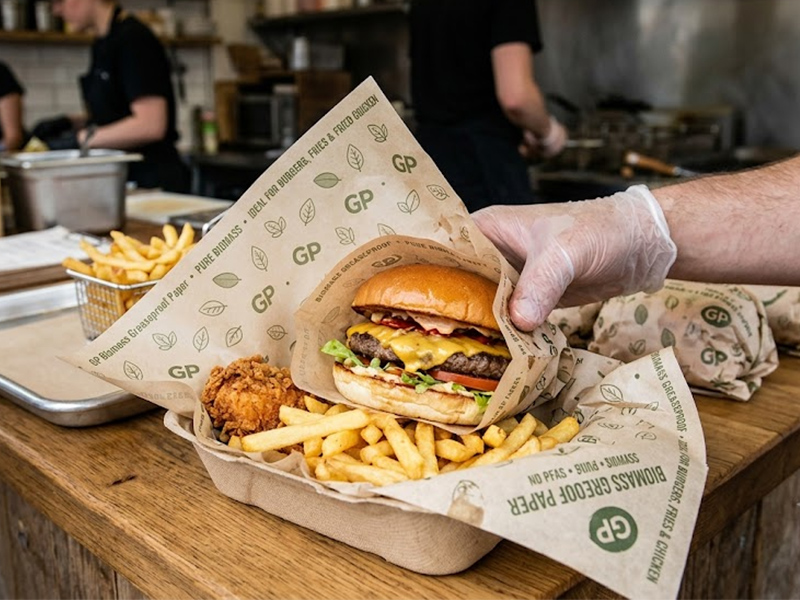
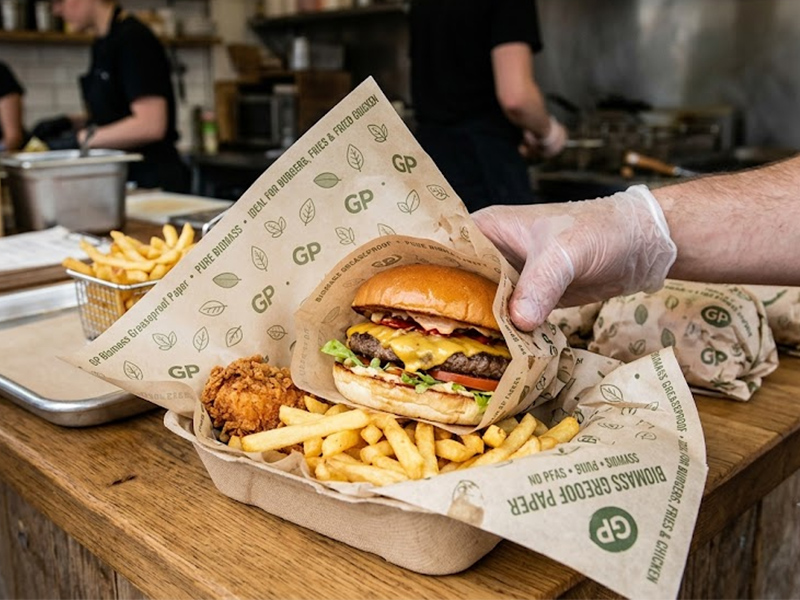
Greaseproof paper is widely used as food packaging paper because many food products contain oils and fats that can penetrate conventional paper.
Common applications include:
Bakery and pastry packaging
Burger and sandwich wrapping
French fry and snack packaging
Food tray liners
Takeaway food packaging
Catering packaging
Confectionery packaging
Food wrapping and interleaving
The appropriate paper grade depends on the food product, packaging format, contact conditions, and required barrier properties. Some applications may require grease resistance alone, while others may need a combination of grease, water, moisture, and heat resistance.
Greaseproof Paper vs. Regular Paper
The main difference between greaseproof paper and regular paper is their ability to resist oil and grease penetration.
Regular paper is generally not designed for direct contact with greasy foods. Oil can penetrate its fiber structure and cause visible staining or reduce the strength of the material.
Greaseproof paper is manufactured with a denser structure and controlled surface characteristics to reduce grease penetration. This makes it more suitable for food packaging applications where contact with oils and fats is expected.
What Should You Consider When Choosing Greaseproof Paper?
Choosing the right greaseproof paper depends on the requirements of the final packaging application. Grease resistance is important, but it is not the only factor that should be considered.
Grease Resistance
The first consideration is the level of resistance required against oils and fats. Products containing significant amounts of grease may require a paper grade with higher barrier performance.
Water and Moisture Resistance
Some food products contain both oil and moisture. If the packaging will be exposed to water, condensation, or wet foods, additional water or moisture resistance may be required.
Heat Performance
For hot food packaging, the paper should be evaluated according to the expected temperature and contact conditions. This is particularly important for takeaway food, bakery products, and food-service packaging.
Strength and Thickness
Basis weight, thickness, tensile strength, stiffness, and folding performance can all affect how the paper performs during converting, filling, transportation, and use.
Printing and Converting
Packaging manufacturers may also need to consider printing, cutting, folding, sealing, and other converting requirements. The selected paper should be compatible with the intended production process.
Why Is Greaseproof Paper Important for Food Packaging?
Greaseproof paper provides an important barrier function while maintaining the basic characteristics of paper-based packaging. It can help reduce oil and grease penetration and improve the appearance and usability of food packaging.
As demand for paper-based packaging continues to develop, manufacturers are also exploring different fiber structures, surface treatments, and coating technologies to improve barrier performance while maintaining the characteristics required for converting and end-use applications.
So, how is greaseproof paper made? The process generally begins with carefully selected cellulose fibers and includes pulp preparation, refining, sheet formation, pressing, drying, and finishing. The paper's dense fiber structure plays an important role in its resistance to oils and grease, while additional surface treatments or coatings can be used when other barrier properties are required.
Understanding the greaseproof paper manufacturing process can help packaging buyers choose a suitable material for different applications. From bakery wrapping and catering packaging to takeaway food packaging, greaseproof paper can provide useful grease-resistant properties for a wide range of food packaging applications.
For companies looking for a suitable greaseproof paper manufacturer or greaseproof paper supplier, it is important to evaluate not only grease resistance but also water resistance, heat performance, strength, converting requirements, and the specific needs of the final packaging application.