Can High Barrier Paper Replace Plastic Packaging?
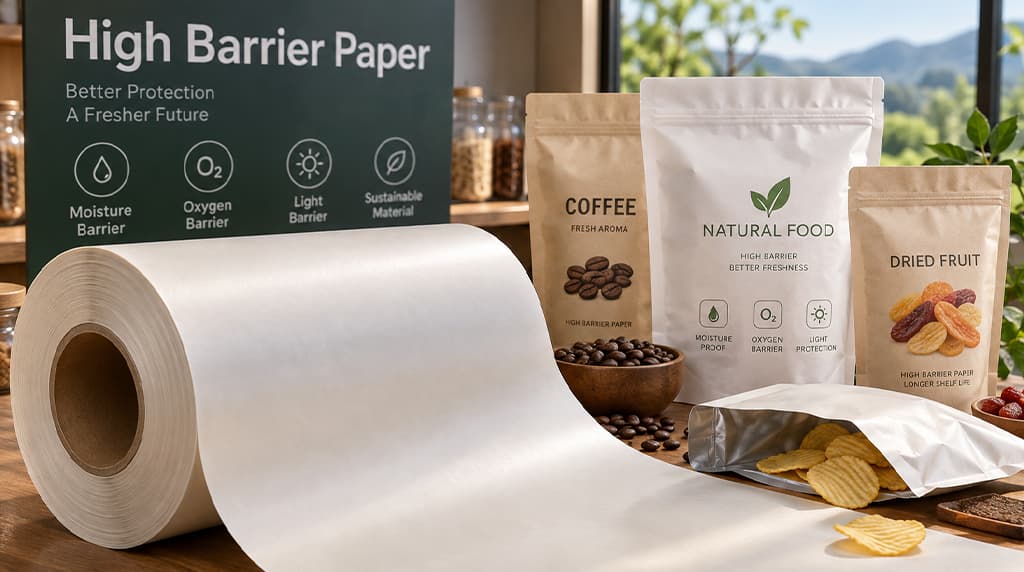
Yes, High Barrier Paper can replace certain types of plastic packaging, but it is not a universal replacement for every plastic package. High Barrier Paper is engineered to provide resistance against oxygen, moisture, grease, and other external factors while maintaining the paper-based structure needed for packaging. Depending on the product, shelf-life requirements, sealing method, and barrier performance required, High Barrier Paper packaging can be a practical alternative to conventional plastic-based packaging.
The growing interest in paper-based packaging comes from the need to reduce dependence on conventional plastic materials while maintaining the functional performance expected from modern packaging. However, choosing between plastic and barrier paper requires more than simply comparing the appearance of the two materials. The packaging must provide the right combination of protection, machinability, durability, and end-of-life characteristics.
What Is high barrier paper?
High barrier paper is a paper-based packaging material designed to provide enhanced protection against substances that can affect the packaged product. Conventional paper naturally allows some moisture and gases to pass through its porous structure. High barrier paper addresses this limitation by using specially designed coatings, treatments, or barrier layers.
Depending on the construction, a high barrier packaging material may provide protection against oxygen, water vapor, moisture, oil, grease, aroma, and other external influences. Some grades can also be designed for heat sealing, making them suitable for pouches, bags, sachets, wraps, and other flexible packaging formats.
The exact performance of a high barrier packaging paper depends on its coating technology, paper substrate, thickness, barrier layer, converting process, and intended application.
Why Is High Barrier Paper Considered an Alternative to Plastic?
Plastic packaging has traditionally been widely used because it can combine flexibility, strength, moisture resistance, and strong barrier performance in a relatively lightweight material. However, businesses looking for paper-based packaging alternatives are increasingly evaluating materials that can provide similar functional properties while using a paper substrate.
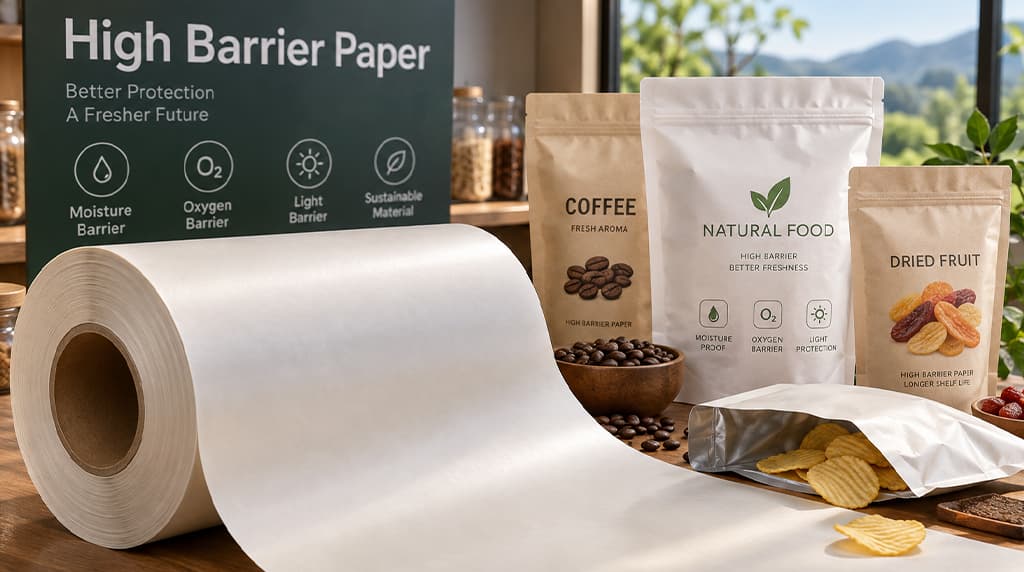
High barrier paper packaging can provide several advantages in applications where paper-based packaging is suitable:
It provides a paper-based packaging structure.
It can offer improved resistance to moisture and oxygen compared with untreated paper.
It can provide grease and oil resistance for selected applications.
Some grades can be heat sealed on suitable packaging equipment.
It can support paper-oriented packaging designs and branding.
It may reduce the amount of conventional plastic used in certain packaging structures.
However, these benefits do not mean that high barrier paper performs identically to every plastic film. The appropriate material depends on the requirements of the packaged product.
How Does High Barrier Paper Compare With Plastic Packaging?
The main difference is the underlying material structure. Plastic films are generally produced from polymer materials, while barrier packaging paper starts with a paper substrate and adds functionality through coatings or barrier layers.
Plastic can provide very high resistance to moisture and gases, depending on the polymer and film structure. High barrier paper attempts to achieve the necessary level of protection while retaining the characteristics of a paper-based substrate.
This makes high barrier paper particularly interesting for products where the packaging does not require the extreme barrier performance or mechanical properties of a multilayer plastic structure.
Can High Barrier Paper Provide Moisture Protection?
Yes. One of the main purposes of a high barrier structure is to reduce the transmission of moisture through the packaging. Untreated paper is relatively porous, so it is not naturally suitable for applications requiring strong moisture resistance.
Barrier coatings can reduce water vapor transmission and improve the paper's resistance to direct contact with moisture. The actual performance depends on the coating technology, paper construction, environmental conditions, and packaging design.
For products that are particularly sensitive to humidity, packaging developers should evaluate the material's water vapor transmission rate rather than relying only on general descriptions such as "moisture resistant."
Can High Barrier Paper Provide Oxygen Protection?
High barrier paper can also be engineered to provide oxygen barrier properties. Oxygen can negatively affect products through oxidation, flavor changes, color changes, and loss of product quality.
The oxygen barrier performance of a material is commonly evaluated using oxygen transmission rate, or OTR. A lower OTR generally indicates that less oxygen passes through the packaging under the specified test conditions.
For oxygen-sensitive products, selecting the correct high barrier paper requires testing the actual material structure under conditions relevant to the intended application.
Can High Barrier Paper Replace Plastic Bags and Pouches?
In some applications, yes. High barrier paper can be used for certain bags, pouches, sachets, and other flexible packaging structures. Whether it can completely replace a plastic bag depends on the product requirements.
For example, dry products with moderate moisture and oxygen sensitivity may be good candidates for paper-based barrier packaging. Products that require extremely high moisture resistance, very long shelf life, high flexibility, or exceptional mechanical strength may require a different packaging structure.
Can High Barrier Paper Replace Plastic in Food Packaging?
Potentially, but food packaging requires additional considerations. The material must be appropriate for the intended food-contact application and provide adequate protection throughout the product's shelf life.
Factors such as food composition, moisture content, oil content, oxygen sensitivity, storage temperature, filling process, sealing conditions, and distribution environment all influence material selection.
Therefore, high barrier paper packaging should be selected according to the complete packaging specification rather than simply replacing a plastic film with paper.
What Are the Limitations of High Barrier Paper?
High barrier paper is not a direct replacement for every plastic packaging format. Several limitations should be considered.
First, paper naturally has a fibrous structure, so achieving high levels of moisture and gas protection can require additional functional layers. Second, folding, creasing, cutting, and converting can affect barrier performance if the barrier layer is damaged. Third, some applications require mechanical flexibility or sealing performance that may be easier to achieve with plastic films.
For these reasons, packaging developers should test the finished package rather than evaluating only the flat sheet material.
Is High Barrier Paper More Sustainable Than Plastic?
The answer depends on the complete material structure and its end-of-life pathway. A paper-based package is not automatically more sustainable simply because it contains paper.
The coating, barrier layer, adhesives, inks, manufacturing process, transportation requirements, product protection, and disposal or recycling system can all affect the overall environmental impact.
In practical terms, the sustainability of high barrier paper packaging should be evaluated across its entire life cycle rather than based on the substrate alone.
When Should You Choose High Barrier Paper?
High barrier paper may be worth considering when a packaging application requires a paper-based appearance or structure combined with improved protection against moisture, oxygen, oil, grease, or aroma.
It can be particularly relevant for selected food packaging, dry goods, coffee and tea packaging, snack packaging, sachets, pouches, and other applications where conventional paper does not provide sufficient protection.
Conclusion
High barrier paper can replace plastic packaging in some applications, but it should not be viewed as a universal substitute. Its suitability depends on the required moisture barrier, oxygen barrier, grease resistance, shelf life, sealing performance, mechanical strength, and end-of-life requirements.
For packaging developers, the most effective approach is to define the product's protection requirements first and then select a high barrier paper structure that meets those requirements. When properly matched to the application, high barrier paper can provide a useful paper-based alternative for packaging products that would otherwise rely on conventional plastic materials.
Frequently Asked Questions
Can high barrier paper completely replace plastic?
No. It can replace plastic in selected applications, but products requiring extremely high barrier performance, flexibility, or mechanical strength may still require plastic or other packaging structures.
Is high barrier paper waterproof?
Some grades can provide strong moisture resistance, but waterproof performance depends on the specific coating and material structure.
Is high barrier paper suitable for food packaging?
Some high barrier paper grades are designed for food packaging applications. The material must be appropriate for the intended food-contact and performance requirements.
What does high barrier paper protect against?
Depending on its construction, it can provide protection against oxygen, moisture, water vapor, oil, grease, aroma, and other external factors.