What Is A Substitute for Greaseproof Paper?
Greaseproof Paper is widely used in food packaging, baking, wrapping, and industrial applications because it provides resistance against oil and grease. However, it is not always the most suitable material for every application. Depending on the required grease resistance, moisture resistance, heat resistance, flexibility, recyclability, and packaging performance, several materials can be used as a greaseproof paper substitute.
Common alternatives include grease-resistant paper, coated paper, parchment paper, glassine paper, kraft paper with a functional barrier coating, and specialty barrier papers. Some materials rely on dense fiber structures to slow oil penetration, while others use a surface coating or treatment to create an additional barrier.
Understanding how these materials work, how they are manufactured, and where they perform best can help packaging manufacturers and buyers select the right paper for a specific application.
How Does Greaseproof Paper Work?
The basic function of greaseproof paper is to prevent oil and grease from penetrating through the paper and reaching the outside surface of the package.
Traditional paper is made from a network of cellulose fibers. Although this structure provides strength and flexibility, it also contains small pores and capillary channels. Liquid oil can gradually move through these channels by capillary action.
Greaseproof paper reduces this penetration by creating a much denser fiber network. During production, the paper fibers are highly refined and processed to reduce the size and number of pores. The resulting structure has a lower permeability to oils and fats.
Another important factor is surface energy. When the paper surface has low affinity for oil, grease is less likely to spread and penetrate into the fiber network.
Depending on the product design, manufacturers can combine several barrier mechanisms, including:
Dense cellulose fiber structure
Surface sizing
Functional barrier coatings
Oil-repellent treatments
Laminated structures
Moisture and grease barrier layers
Therefore, a modern grease-resistant paper does not necessarily depend on one technology. Its performance can come from the combination of fiber density, surface treatment, coating technology, and material formulation.
What Materials Can Replace Greaseproof Paper?
There is no single substitute that works for every application. The best option depends on the required barrier performance and the intended end use.
Parchment Paper
Parchment paper is one of the most familiar alternatives for baking and food preparation. It is generally made from cellulose-based paper that has been treated to improve resistance to grease and moisture.
Its smooth surface and non-stick characteristics make it suitable for baking trays, food wrapping, bakery products, and cooking applications.
The main advantages are good grease resistance, heat resistance, and ease of handling. However, parchment paper may be more expensive than conventional packaging paper and may not be necessary for applications that only require basic oil resistance.
Glassine Paper
Glassine is a smooth, translucent paper produced from highly refined cellulose fibers. The manufacturing process creates a dense and relatively impermeable sheet.
Because of its smooth surface and resistance to grease, glassine can be used for food wrapping, bakery packaging, confectionery packaging, labels, and protective interleaving.
Its main limitation is that glassine is not designed to provide strong moisture or liquid-water resistance by itself. When an application requires multiple barrier properties, additional treatment may be necessary.
Coated Paper
Coated paper can provide a more customized alternative. A functional coating is applied to the paper surface to create a Grease Barrier Paper structure.
Depending on the formulation, coatings can be designed to improve resistance to oil, grease, water vapor, or liquid water.
The coating may be applied through processes such as rod coating, blade coating, gravure coating, or other industrial coating methods. The choice depends on the coating material, paper substrate, production speed, and required barrier performance.
The major advantage of coated paper is flexibility. Manufacturers can adjust the coating formulation and coat weight according to the intended application.
However, coating technology also introduces additional manufacturing steps and requires careful control of coating uniformity, drying, adhesion, and surface properties.
Kraft Paper with a Barrier Treatment
Kraft paper is valued for its high tensile strength and durability. On its own, standard kraft paper does not provide the same level of grease resistance as specialized greaseproof grades.
However, it can be modified with a functional barrier layer or surface treatment.
This approach is useful when packaging requires both mechanical strength and resistance to oil or grease. It is particularly relevant for food-service packaging, takeaway packaging, industrial wrapping, and flexible paper packaging.
The disadvantage is that the final barrier performance depends heavily on the treatment technology. A poorly designed coating can crack, delaminate, or lose performance during folding and converting.
Manufacturing Process of Grease-Resistant Paper Alternatives
The manufacturing process varies according to the selected material, but several important stages are commonly involved.
1. Fiber Preparation
Most paper-based alternatives begin with cellulose fibers. The fibers are pulped, cleaned, refined, and mixed with water to form a paper-making slurry.
Fiber refining is particularly important because it affects the bonding between cellulose fibers. More refined fibers can create a tighter structure with smaller pores.
2. Sheet Formation
The fiber slurry is distributed onto a forming section, where water is removed and a continuous wet paper web is created.
The distribution of fibers needs to be controlled carefully because variations in formation can affect thickness, porosity, strength, and barrier performance.
3. Pressing and Drying
Mechanical pressing removes additional water and increases fiber-to-fiber contact. The paper is then dried under controlled conditions.
For grease-resistant applications, density and porosity are critical parameters. A more compact paper structure can reduce the pathways through which oil migrates.
4. Surface Treatment or Coating
If additional barrier performance is required, the paper may undergo surface sizing, coating, or functional treatment.
A coating can create an additional physical barrier between the paper substrate and the oil. Depending on the formulation, it can also provide resistance to water, moisture, chemicals, or other substances.
Coating weight, viscosity, drying temperature, surface tension, and coating uniformity all influence the final performance.
5. Finishing and Converting
After treatment, the paper is calendered, wound, slit, cut, or converted into the required packaging format.
Calendering can improve smoothness and surface uniformity, while converting determines the final dimensions and usability of the material.
Advantages and Disadvantages of Greaseproof Paper Substitutes
Choosing an alternative requires more than comparing grease resistance. Packaging designers should consider the complete performance profile.
Grease-resistant paper is a practical option when the main requirement is protection against oils and fats. It can provide a good balance between functionality, printability, and paper-based packaging performance.
Parchment paper offers strong performance in baking and high-temperature food applications, but its cost may be higher for simple wrapping requirements.
Glassine paper provides a smooth, dense surface and good grease resistance, but its moisture barrier performance can be limited.
Coated paper offers greater flexibility because the barrier layer can be engineered for specific requirements. However, coating adds complexity to production and may affect recyclability depending on the coating chemistry.
Kraft paper with a barrier treatment provides excellent mechanical strength while adding functional resistance to grease. Its performance depends strongly on the quality and consistency of the barrier treatment.
There is therefore no universal best substitute. The appropriate choice depends on the balance between barrier performance, strength, heat resistance, appearance, processing requirements, and cost.
Applications of Grease-Resistant Paper Alternatives
These materials are used across a wide range of industries.
Food Packaging
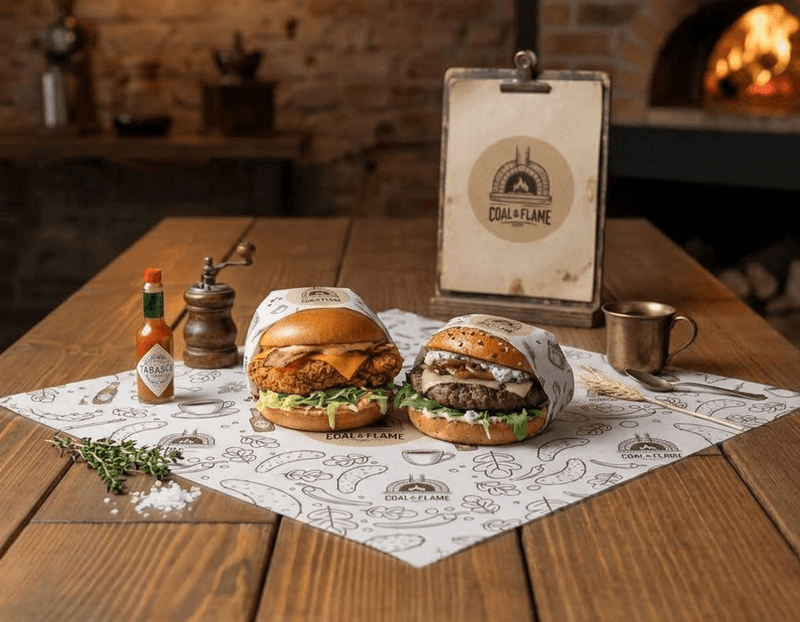
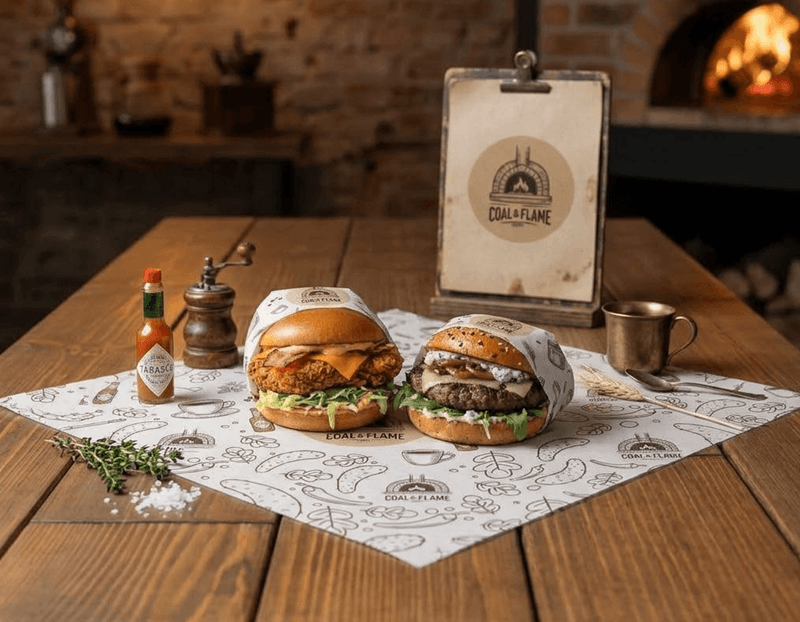
Food packaging is one of the largest application areas. Paper-based barrier materials can be used for burgers, sandwiches, fried foods, bakery products, pastries, snacks, and other products containing oils or fats.
The material helps reduce grease migration and prevents the packaging from becoming excessively stained or weakened.
Bakery and Baking
Baking applications require materials that can withstand contact with oil and, in some cases, elevated temperatures.
Parchment paper and specialized baking papers are commonly selected because they combine grease resistance with heat resistance and easy release properties.
Takeaway and Food-Service Packaging
Takeaway packaging often requires a combination of mechanical strength and grease resistance. Barrier-treated kraft paper and coated paper can be used for bags, wraps, liners, food trays, and other packaging formats.
Industrial Applications
Outside the food industry, oil-resistant paper materials can also be used as protective interleaving materials, component wrapping materials, and specialty industrial packaging.
The required performance in these applications may be different from food packaging. For example, mechanical strength, dimensional stability, oil resistance, and compatibility with industrial fluids may be more important than heat resistance.
How to Choose the Right Substitute for Greaseproof Paper
When selecting a material, buyers should first identify the type of barrier required.
If the application mainly involves direct contact with oily food, a dedicated oil-resistant or grease-resistant paper may be sufficient.
If high-temperature baking is involved, parchment-type materials may be more appropriate.
If the packaging needs high mechanical strength, kraft paper with a functional barrier can offer a better balance.
If multiple barrier properties are required, such as resistance to grease, moisture, and liquid water, a coated or multi-layer paper structure may be a better solution.
Other factors should also be evaluated, including basis weight, thickness, tensile strength, Cobb value, KIT rating, grease resistance, water resistance, heat resistance, surface smoothness, printability, and converting performance.
For food-contact packaging, regulatory compliance and the suitability of the coating or treatment for the intended application should also be considered.
Final Thoughts
So, what is a substitute for greaseproof paper?
The answer depends on the application. Parchment paper, glassine paper, coated paper, and barrier-treated kraft paper can all serve as alternatives when their performance characteristics match the packaging requirements.
The key difference is how each material controls oil migration. Dense cellulose structures reduce the pathways available for grease penetration, while functional coatings and surface treatments can create an additional barrier layer.
For manufacturers, choosing the right material is therefore a balance between grease resistance, moisture resistance, heat resistance, mechanical strength, processing performance, cost, and end-use requirements.
Rather than simply looking for a material that can replace greaseproof paper, it is more effective to identify the required barrier properties first and then select the paper structure and treatment technology that can deliver those properties.