What Is High Barrier Paper for Food Packaging?
How Does High Barrier Paper Protect Food Packaging?
Food Packaging Paper has to do more than simply hold a product. Depending on the application, it may need to resist grease from fried foods, prevent moisture from weakening the paper, limit oxygen transmission, or maintain its performance during heat sealing and transportation. This is where High Barrier Paper becomes useful.
Unlike conventional paper, which is naturally porous, High Barrier Paper is engineered to provide additional protection through its fiber structure, surface treatment, and barrier coating system. The exact construction depends on what the packaging needs to protect against. A paper designed for oily bakery products, for example, may require strong grease resistance, while packaging for moisture-sensitive foods may place greater emphasis on moisture and oxygen barriers.
For manufacturers and packaging converters, understanding these differences is important when selecting high barrier paper for food packaging. The right material is not simply the one with the highest barrier rating, but the one that provides the required performance for the finished package.
What Does High Barrier Paper Protect Food From?
The main purpose of high barrier packaging paper is to control the movement of substances through the paper structure. Depending on its construction, it can provide resistance to grease, oil, moisture, water vapor, and oxygen.
These barriers help prevent several common packaging problems. Oil can migrate through untreated paper and create stains on the outside of a package. Moisture can reduce paper strength or affect the texture of dry foods. Oxygen can contribute to oxidation in products that are sensitive to air exposure.
Rather than treating all of these requirements as one property, packaging engineers normally evaluate each barrier separately and select a paper structure that matches the application.
How Does High Barrier Paper Resist Grease and Oil?
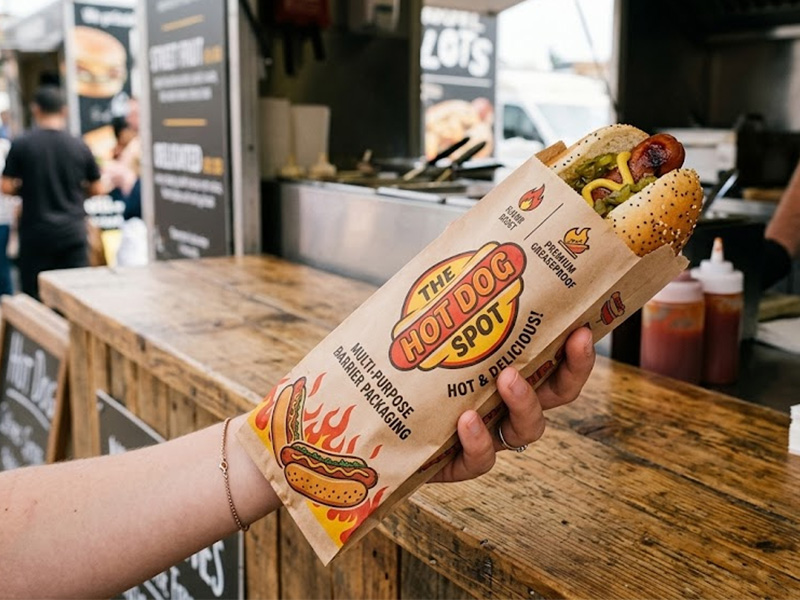
Grease resistance is particularly important for packaging products containing oils and fats. Fried foods, pastries, cookies, butter-based products, and many takeaway foods can release grease during storage or transportation.
Ordinary paper contains microscopic spaces between cellulose fibers. Without suitable treatment, liquid oil can gradually migrate through these spaces. High barrier paper can reduce this migration by using a denser paper structure and, where required, a functional surface treatment or coating.
This is one reason high barrier materials are often considered alongside grease resistant paper and greaseproof paper. However, the terms are not interchangeable. Greaseproof paper is primarily designed around resistance to oil and grease, while a high barrier structure may be engineered to provide several different barrier properties at the same time.
How Does High Barrier Paper Control Moisture?
Moisture is another major concern in paper-based food packaging. Paper fibers naturally interact with water, so exposure to liquid water or high humidity can affect the strength, stiffness, and appearance of the package.
A suitable moisture barrier reduces the amount of water or water vapor that can pass through the packaging structure. This can be achieved through the selection of the paper base and the use of an appropriate barrier coating or surface treatment.
For example, packaging used for foods with a high moisture content may require a different barrier structure from packaging intended for dry snacks. The expected storage environment also matters. A package used in a refrigerated or humid environment may have different moisture resistance requirements from one stored under dry conditions.
Why Is Oxygen Barrier Performance Important?
For some foods, exposure to oxygen can gradually affect product quality. Oxidation may influence flavor, aroma, color, or the shelf life of products that are sensitive to air.
An oxygen barrier works by slowing the transmission of oxygen through the packaging material. The level of protection depends on factors such as the coating chemistry, paper structure, coating thickness, temperature, and relative humidity.
Not every food product requires a high oxygen barrier. This is an important point when selecting barrier paper packaging. The barrier level should be matched to the product rather than selected simply because a higher specification sounds better.
Can High Barrier Paper Be Heat Sealed?
Some high barrier paper structures are designed to be heat sealable. This allows the material to be converted into packaging formats such as pouches, sachets, wrappers, and other sealed structures.
Heat sealing creates a closed package and helps protect the contents from external moisture and air. For packaging manufacturers, however, barrier performance is only one part of the requirement. The material also needs to provide consistent sealing performance at the temperatures and production speeds used by the packaging equipment.
Factors such as sealing temperature, dwell time, pressure, coating structure, and seal strength should therefore be considered when selecting a heat-sealable paper.
How Does the Paper Structure Affect Barrier Performance?
The performance of high barrier paper does not come from the coating alone. The paper substrate provides the foundation for the final material, and its characteristics can influence coating uniformity, strength, stiffness, and converting performance.
Fiber Structure
The arrangement and density of cellulose fibers affect how easily liquids and gases can move through the sheet. A controlled fiber structure can provide a better base for achieving consistent barrier performance.
Coating Technology
Barrier coatings are used when the application requires additional resistance beyond what the paper substrate can provide. Different coating systems can be developed for grease, moisture, oxygen, or combinations of these requirements.
Coating Weight and Uniformity
A coating needs to be applied consistently across the paper surface. Variations in coating coverage can affect barrier performance and may become more noticeable during converting or final packaging production.
Paper Thickness and Basis Weight
Thickness and basis weight affect more than barrier performance. They also influence stiffness, folding behavior, printing, sealing, and the overall feel of the finished package. These specifications should therefore be selected together rather than considered independently.
Where Is High Barrier Paper Used in Food Packaging?
The application of food packaging paper depends on the barrier properties required by the product. High barrier paper can be used where conventional paper does not provide sufficient protection.
Bakery and Pastry Packaging
Pastries, cookies, cakes, and other bakery products can contain oils and fats that migrate into paper packaging. A suitable barrier structure can help reduce grease penetration while maintaining the appearance and handling properties of the package.
Snack Packaging
Snacks may require protection from oxygen and moisture, particularly when product freshness is important. The required barrier level depends on the food composition, storage period, and packaging format.
Takeaway Food Packaging
Takeaway packaging can face several challenges at once: hot food, grease, moisture, condensation, and transportation. A paper structure with the appropriate combination of barrier properties can provide better performance than untreated paper.
Food Wrappers and Liners
High barrier paper can also be converted into wrappers, liners, sheets, and other packaging components where resistance to oil or moisture is required.
High Barrier Paper vs. Greaseproof Paper
High barrier paper and greaseproof paper are related, but they are not necessarily the same material.
| Property | High Barrier Paper | Greaseproof Paper |
|---|---|---|
| Primary purpose | Can provide multiple barrier properties | Mainly focused on grease and oil resistance |
| Moisture barrier | Can be engineered for improved moisture resistance | Depends on the specific grade |
| Oxygen barrier | Can be incorporated into the barrier structure | Usually not the primary function |
| Typical applications | Specialized food and flexible paper packaging | Food wrapping, liners, bakery and takeaway packaging |
The choice between the two should be based on the actual packaging requirements. If grease resistance is the main concern, greaseproof paper may be sufficient. If the package needs a combination of grease, moisture, oxygen, and sealing performance, a more advanced high barrier structure may be appropriate.
How Should You Choose High Barrier Paper for Food Packaging?
There is no single high barrier paper specification that works for every food product. Before selecting a material, buyers and packaging manufacturers should define the conditions the package will face.
Food characteristics: Determine whether the product is oily, moist, dry, acidic, or sensitive to oxygen.
Required barrier properties: Identify whether grease, moisture, water vapor, or oxygen resistance is required.
Packaging format: Consider whether the material will be used as a wrapper, bag, pouch, liner, or another structure.
Converting process: Check compatibility with printing, folding, forming, coating, and heat-sealing equipment.
Storage conditions: Consider temperature, humidity, transportation, and expected storage time.
Regulatory requirements: For food-contact applications, confirm that the selected material meets the requirements applicable to the target market and intended use.
Providing these details to a high barrier paper manufacturer can make material selection more accurate and reduce the risk of choosing a paper with unsuitable barrier or converting performance.
What Should You Ask a High Barrier Paper Supplier?
When working with a high barrier paper supplier, it is useful to ask for more than a general product description. Buyers should understand which barrier properties the material is designed to provide and how those properties were evaluated.
Useful information may include grease resistance, moisture or water vapor barrier performance, oxygen transmission, basis weight, thickness, coating structure, heat-sealing conditions, printing compatibility, and available customization options.
For large-volume packaging projects, requesting samples and testing the paper on the actual packaging equipment can also help verify whether the material performs as expected in production.
Frequently Asked Questions
What does high barrier paper protect against?
Depending on its construction, high barrier paper can provide resistance to grease, oil, moisture, water vapor, and oxygen. The actual barrier performance varies by material grade and application.
Is high barrier paper suitable for food packaging?
Yes. High barrier paper can be developed for different food packaging applications, provided that the selected grade meets the required performance and applicable food-contact requirements.
What is the difference between high barrier paper and greaseproof paper?
Greaseproof paper primarily focuses on resistance to oil and grease. High barrier paper can be engineered to provide a broader combination of barrier properties, such as grease, moisture, and oxygen resistance.
Can high barrier paper be used for oily foods?
Yes, certain grades are designed with grease and oil resistance for applications involving fried foods, bakery products, snacks, and other products containing fats or oils.
Can high barrier paper be heat sealed?
Some high barrier paper structures include a heat-sealable layer and can be used for pouches, sachets, wrappers, and other sealed packaging formats. The sealing conditions depend on the material construction and packaging equipment.
Conclusion
High barrier paper protects food packaging by controlling the transfer of grease, moisture, oxygen, and other external factors through the paper structure. Its performance is determined by the combination of the paper substrate, fiber structure, surface treatment, barrier coating, and final packaging design.
For food packaging manufacturers, the most suitable material is not necessarily the paper with the highest barrier specification. The better approach is to match the barrier properties with the food product, storage conditions, packaging format, and converting process. Working with an experienced high barrier paper manufacturer or supplier can help buyers develop a paper-based packaging structure that balances protection, processing requirements, and final-use performance.
```